Performed by the Student Association for Fa'asamoa at American Samoa Community College
Wednesday, April 3, 2013

Monday, April 1, 2013
Leai Samoa, ‘ae Leai Amerika (Not Samoa, but Not America)
It is not very surprising to
me to realize that many Americans don’t know about the US territory of American
Samoa. Being a US territory is an interesting position; American Samoans are US
nationals, not citizens, meaning they have US passports, birth certificates,
and social security cards, are allowed to fight in US wars (and many of them
do), but are, for the most part, self-governing and are citizens of their own
state, Amerika Samoa.
The history of the Samoan
islands is incredibly complicated, mainly rooted in colonial superpowers
squabbling over Samoan harbors for military use. Before WWII, Savai’i and
‘Upolu (formerly Western Samoa) were colonies of Germany. After WWII, these
were Samoan islands were “taken” from Germany and became UN Trust Territories
administered by New Zealand. The islands of Tutuila, Ofu, Olosega, and Ta’u
(formerly Eastern Samoa) had been US territories since 1900 when the high
chiefs of these islands signed a deed of cession, which agreed to allow the US
use of the ports if the US protected the rights of the natives. Tutuila, Ofu,
Olosega, and Ta’u—now known as Amerika Samoa—have remained a US territory ever
since.
For 113 years, “Western” and
“Eastern” Samoa have been divided along lines that they did not create
themselves. Although American Samoans and Samoans speak the same language,
generally eat the same foods, follow the same customs, go to similar churches,
and live similar lives, the realities of these islands are inherently situated
in colonial military history.
Unfortunately our group was
only able to stay in Amerika Samoa for three nights. As I mentioned earlier, I
traveled back in time to get to the island, which is only half an hour by plane
(a very small plane). Landing in the Tafuna Airport (a very small airport),
everything seemed to be the same. The landscape was similar and the airport was
one I would expect to see in Samoa, but upon entering the baggage claim, I was
hit in the face by a wall-sized Ford Motors advertisement with a backdrop of
the American flag.
Driving to Pago Pago
(pronounced pahn-go pahn-go) I began to notice the difference. Not only were we
finally driving in the right side of the road again, but everything here was
bigger: bigger cards, bigger houses, bigger buildings, and bigger people. The
roads were paved nicely and we caught glimpses of Pizza Hut, McDonalds, and KFC
along the way. It definitely had a more familiar feel to it, but in an
indescribable way.


 |
| The most American housing I'd seen in months |
We were stationed at American
Samoa Community College (ASCC) and that’s when I really felt at home. It was a
lot like a community college campus you would see in the states and most people
were speaking English, even in their private conversations. We were hosted by
the Student Association for
Fa’asamoa (SAF), a student group that performs songs and dances and a
variety of others things in order to keep the fa’asamoa (the Samoan way) alive. I was lucky enough to be hosted
by Vailuluu, or Vai—her spunk and attitude gave me energy throughout the whole
trip. We really got along, so well in fact that I’m hoping to figure out a way
to visit Amerika Samoa in the next few months.
Vai and I took the bus from
the college to her village of Atu’u, the home of the Amerika Samoa StarKist
cannery. It’s also the home of the Amerika Samoa StarKist cannery smell. On the
way to her house it wasn’t hard to miss the cannery (and at least her house was
far enough up the mountain to evade most of the smell). Factory workers crowded
around the small shops of her village street—some American Samoan, some Samoan,
some from Vanuatu, some from China. For the most part I’m not one for canned
tuna but at home StarKist is all I’ve seen. Of course this cannery is one of
many but it was a little disconcerting and strengthened my general disinterest
in canned tuna.


 |
| Vai and me! |
Before going to Vai’s house,
we went to her church’s Easter performance practice. A room full of about 50
American Samoans shuffled and turned toward the unexpected pālagi as she walked into their space. People stared me down and
the girls around me, Vai’s friends, were immediately interested in who I was
and why I was there. They commented on my blue eyes first of all, and I laughed
as I vaguely understood them talking about me with Vai and hearing her
response, “e lo’u kausona,” she’s my
cousin.
Vai’s home was up the
mountain on a steep set of stairs with different fale breaking off at different paths. The village was literally
built into the mountain, where someone’s front (paved) “yard” was another
person’s driveway, which was another person’s backyard. We stayed in her
sister’s house with her sister’s husband and three children. Up the mountain
was where her mom and dad and several brothers (I actually never counted how
many) stayed with various children and other people. Vai moved between these
homes as is common in Samoa. We spent the night dancing and giving the pālagi pointers on the Samoan dance we
would perform the next day and gorged ourselves on the American junk food I had
missed so much like oreos and Doritos.
 |
| View from the porch of Vai's house |

 |
| Vai's house! |
 |
| Stairs up the mountain |
The next day we hiked Mount ‘Alava. Although it wasn’t the most beautiful hike I’ve been on in Samoa, it was certainly the hardest. Seven miles in three hours of mostly uphill terrain in the Samoan humidity is not something I’d really recommend. The view from the top was outstanding though, and the top of the mountain actually was directly above Vai’s house. It was the view I was used to from outside my house, but just higher up. We were able to see the whole Pago Pago Harbor with the reef and everything. On the way back down two of us cut our legs slipping on the rocks, but luckily there was American medical system to the rescue.
 |
| View of the north shore of Tutuila |
 |
| Pago Pago harbor, the south shore of Tutuila |
 |
| View of Pago Pago from the top of Mount 'Alava |

 |
| Amy is a champ |
Our last night, funny
enough, was spent watching G.I. Joe the movie in the Pago theater with all the pālagi and their hosts. I wasn’t
thrilled about the movie choice (and it actually ended up being ok), but it was
the first time where I felt completely in America. With popcorn and M&Ms,
shrouded by the darkness of a familiar setting, there was no reason to believe
that I was in the middle of the Pacific Ocean, thousands of miles away from
American shores. What’s better, we went to Carl’s Jr. for dinner after the
movie.
Our last day was a little
bitter because we quickly realized what a short amount of time we were given to
explore Amerika Samoa. After a few more lectures and an excursion to some lava
fields near the college, we had lunch with the students and watched their dance
practice. Again, I was overwhelmed with how magnificent their dancing is. It’s
hard not to be impressed with the grace and complexity of these dances, all in
unison.


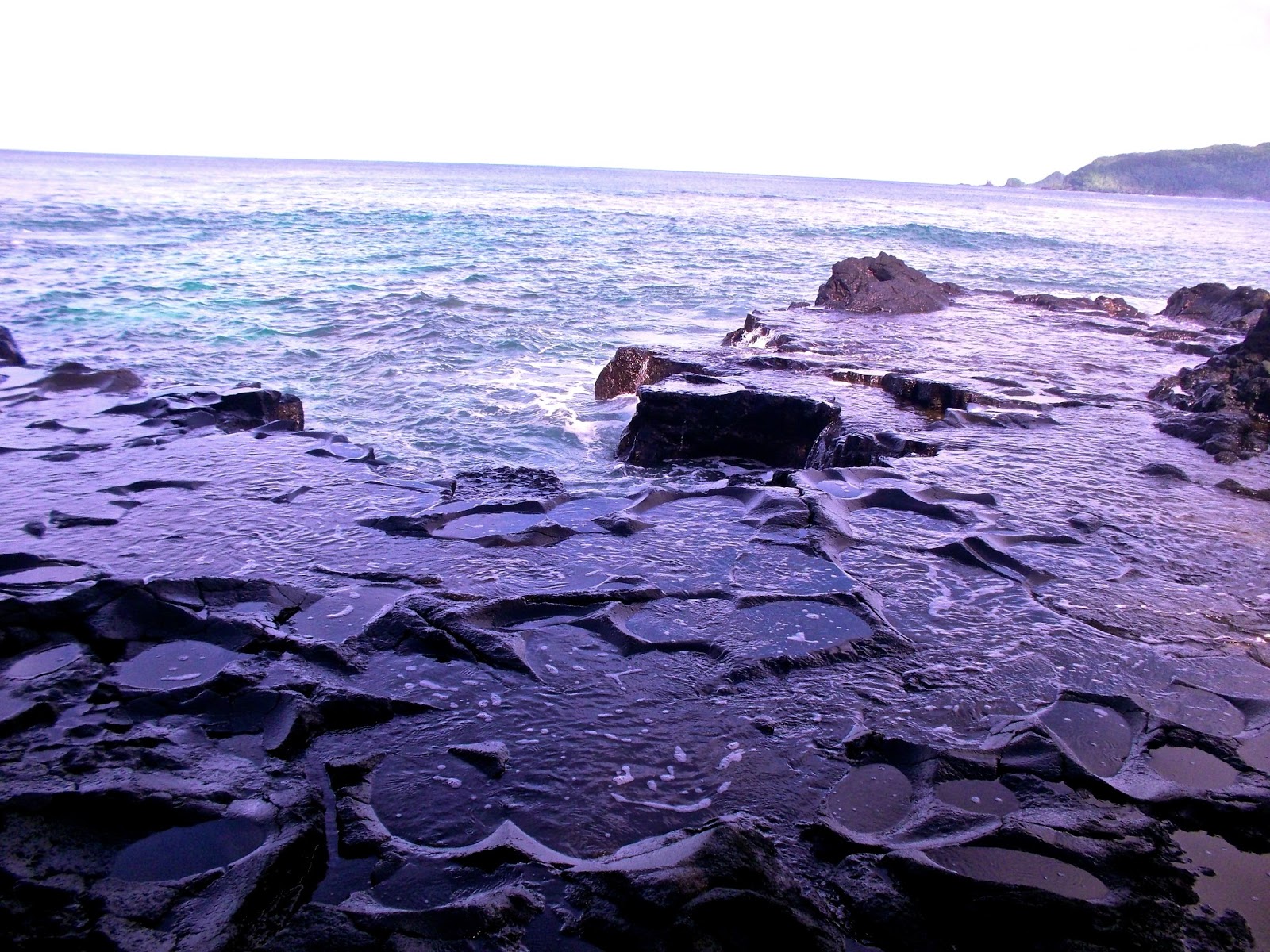 |
| More lava fields |
 |
| Some of the other hosts |
 |
| Vai dancing beautifully |


Throughout the trip, I would
meet people from many aspects of Amerika Samoa (or at least Vai’s Amerika
Samoa). The sister we were staying with actually worked for the government and
had some insight on one viewpoint of Amerika Samoa’s position within the US.
Because of the history Hawai’i has with moving from a US territory to statehood
has convinced her that Amerika Samoa should be spared the same fate. The difference
between Hawai’i and Amerika Samoa, at least, is that the culture is alive and
rich. Samoan is the primary language of each home, the customs are breathing in
the clothing, food, and interactions, and for all intents and purposes everyone
still identifies as Samoan. This is key: as a US territory, Amerika Samoa has
become an entity of its own. The few people I spoke with openly stated the
distinct difference between themselves and “Western” Samoans (as they are still
called).
I noticed it too, especially
in my own behavior. It was almost too easy to slip out of my newly formed
Samoan skin I’ve been working on and act and talk in the way I do at home. The
Samoan students were incredibly adaptable and supported this role in us; they
wanted to talk about the same things we did. Their conversations with each
other consisted of pieces of Samoan and English here and there. They used their
iPads to connect to WiFi in Carl’s Jr. to find us all on Facebook.
Not that it should, but none
of this bothered me. In fact, I really liked it. I felt I had reclaimed a piece
of myself that had been unused for the past few months despite my (rather
constant) contact with the other pālagi.
I think it’s very telling of the pieces of my own culture that I crave for.
It’s hardly the fast food, but more the shared reality of how the world works
and my own place in it, and the things I’m interested in doing within that
place. Things like Facebook, although they are very present in independent
Samoa, are discussed and understood in a very different way that has a pretty
distinct flavor of foreign. In Amerika Samoa, it tastes a bit more
recognizable.
And why, I have to ask
myself, was I more bothered by this in Hawai’i than in Amerika Samoa? Think
about it: a very similar process is happening that can be described as
“Americanization,” where Amerika Samoa—for better or for worse—is being
squeezed into the vortex of American food, language, dress, interests, and
social lives. The reality of tourism in Hawai’i frustrated me to the point of
disgust, but seeing it in Amerika Samoa at this point in my trip was liberating
and nostalgic. I know some of it has to do with Amerika Samoa’s conservation of
the fa’asamoa, a privilege that
native Hawaiians were not granted through their history with the United States.
But another part of it has to do with me and my intrinsic Americanness. I’m
starting to see and feel the parts of fa’asamoa
that I want to bring back with me to my fa’aamerika,
and those that I don’t want to bring back. Through all of this, I’m a bit
confused—as I always am—with who I am in this place or that place. Although
this trip was a remarkably positive experience with Vai who showed me so many
parts of her life, I came back with a sour taste of enjoyment and aversion to
something so familiar yet so foreign.
Arriving in Apia, we took
the weekend at another beach fale spot
on the southeast side of ‘Upolu, in Lalomanu. Mickey, Amy, Meg and I enjoyed
the weekend of relaxation, and it felt powerful to be able to go around the
island on our own without so much as a second guess. We met Mika, a man from
Tokelau that happened to be the former student of our academic director, Jackie.
He might have been the funniest and most lively Pacific Islander that I’ve met
to date, and that’s saying something.

 |
| Taufua beach |
 |
| Mika our new best friend |

I send my love!
Monday, March 25, 2013
Ioe, pisi le vaiaso
Later today we'll be traveling to American Samoa and I figured I'd get in touch with the other side of the world before we leave. I'll be in the capital of Pago Pago for three nights, Tuesday to Friday for me, Monday to Thursday for all of you in that time zone. In American Samoa, I'll be living with another family, set up through the Community College of American Samoa. It's bound to be interesting -- American Samoa is a US territory (obviously) and, from what I've heard, has retained a lot of Samoan culture, but has picked up some of the worst of American culture. But, for a few days, I'll be on the same day as all of you; we leave Tuesday March 26 at 2:30 in Samoa...arrive Monday March 25 at 2:00 in American Samoa. It's weird that I'm getting more used to this time travel thing.

This past week was incredibly busy--pisi le vaiaso--as we started our work for our Independent Study Projects. I'll be looking at cultural perceptions of pregnancy again. After interviewing a few women, I was reminded why I love this topic so much. Watching women's faces as they explain and laugh with their experiences is a beautiful thing. I'm collecting quite a few narratives, and quite a few beliefs associated with pregnant women. For example, she should never drink niu (coconut water) from a coconut that has been cut with a big hole lest her baby be born with a huge mouth. And don't tie your lavalava above your breasts because you wouldn't want the baby to be born without arms!
I'll update more on my return from your time zone.
Tele alofa!

This past week was incredibly busy--pisi le vaiaso--as we started our work for our Independent Study Projects. I'll be looking at cultural perceptions of pregnancy again. After interviewing a few women, I was reminded why I love this topic so much. Watching women's faces as they explain and laugh with their experiences is a beautiful thing. I'm collecting quite a few narratives, and quite a few beliefs associated with pregnant women. For example, she should never drink niu (coconut water) from a coconut that has been cut with a big hole lest her baby be born with a huge mouth. And don't tie your lavalava above your breasts because you wouldn't want the baby to be born without arms!
I'll update more on my return from your time zone.
Tele alofa!
Sunday, March 17, 2013
The introspective tourist
Growing
and living in a place of the world where tourism permeates through every
person, place, and thing is an interesting (and often times uneasy) experience.
Samoa, with its clandestine beaches and crystal waters is obviously one of
these destinations, and because of this I’ve had to navigate my identity as a
student, a pālangi, a woman, and especially as a tourist.
Last
Friday my group left by ferry for the island of Savai’i, the largest island of
the Samoan chain of islands that is far less populated and is far more soaked
by tourists. We knew this going into it. We were aware that this trip, unlike
our Lotofaga trip, was somewhat like a vacation (although Jackie obviously does
not use that to describe it). Savai’i harbors active flowing volcanoes (the
last eruption was early 1900s, I think 1907?) so this was our chance to see the
more geological perspectives of the islands.
 |
| Here's a general map of the two main islands of Samoa. I am usually on the island of 'Upolu in the city of Apia. We took a ferry into Salelologa, stayed at Tanu Beach on the east central side of the island, visited Falealupo, the Taga blowholes, hiked Tafua, and swam in Olemoe Falls. |
But before the lectures and hikes on Pacific geology, we were given two free days at the Tanu Beach Fales on the southeast side of the island. Tanu Beach is run by a family of Samoans, which is a common business for some families, especially in Savai’i. They provided for us breakfast and dinner and a comfortable stay in a little fale that made for a beautiful vacation. I woke up in the morning to see those turquoise waters lapping up to me and had the days to relax in the sun, snorkel in the reefs offshore, and experience some other sites that were near the property.
 |
| Our little fales at Tanu Beach |
 |
| The tide would get so high so the bottom two steps of those stairs were covered! Jackie says the family has had to move the beach fales back another few feet almost every year. Can you say rising sea levels? |
 |
One
such site was Paia, the Dwarf’s Cave. It was suggested to us by a few of the family
members at Tanu Beach, and I went into it with very few expectations. Before
this experience, I had never been in a cave before – or at least not a real
cave. I was imagining a hole in the side of a volcano, but the entrance to Paia ended up as a literal hole in the ground, with a relatively sleep
descent into a dark, dripping tunnel. Color and light escaped us as we went
deeper in until I experienced actual darkness for the first time. A shallow
stream of water ran over our feet, collecting in pools along the way. The
pools, lit from our three small light sources, were unclouded and crisp, with
no (visible) things growing in or around them. We were surrounded by water,
rock, and mud only. Some roots pushed through the ceiling, growing more rare as
we descended. The first large pool we came to forced me to leave my shirt and
bag behind, with no way to avoid getting drenched up to my shoulders. The next
pool was even bigger and deeper, where I abandoned my headlamp because I was
required to jump into the pool that was deep enough that I could not stand. From
then on we were reliant on our guide, a fifteen-year-old boy named Junior from
the village. We continued on our way, laughing at ourselves as we slipped from
rock to rock with ungraceful steps. We eventually came to a wall, and as I
assumed that was the end of the cave, Junior got down on his stomach and
squeezed his thin body through a crack in the wall. Watching this alone made my
skin crawl and pushed comfort zones I didn’t even know I had. I followed and entered
a round room. Here, we sat and decided to turn off the remaining light, and
experienced darkness and silence that was foreign to us. In darkness like that,
light and energy plays with you. I had a stained image of that room in my mind
that stayed with me as the light went out, and I felt other’s bodies in a way
that required no sight or sound. It was a cool experience, and having pushed
myself (literally and figuratively) into it made it more powerful. When the
light came back on, I again naively thought that we were going to turn around,
but Junior again got on his belly and found another crack, this time far more
uncomfortable because there was no open room on the other side. This tunnel
steered us for about ten minutes until it was actually time to turn back.
Venturous locals and tourists from previous times had etched their names and
marks into the muddy walls of the tunnel, and I of course followed suit.
Leaving the tight spaces was relieving, but I’m glad I went through it.
Retrospectively I’m not sure why I never stopped to consider why it was called
“Dwarf’s Cave” if not to crawl on my belly, hands, and knees for at least part
of the path. The way back seemed much shorter, as they always do, and I enjoyed
experiencing the checkpoints in a new light. The walls seemed shorter, the
climbs and falls less brooding, and the cave pools cleansing as I had becoming
covered in mud by squeezing through these spaces. As I picked up my left items
on the way back with a clean body, I found it funny that there was no way to
exit that cave without freeing yourself of those necessary inconveniences. You
exit the cave as you entered, maybe a little wetter, but fresh all the same.
 |
| This picture obviously doesn't do it justice, but it's the best the internet had. |
 |
| Exiting Paia, speechless |
The next day we met an Aussie geologist (world famous, I might add) named Warren Jopling. At the age of 84, his natural spark was spiced with his old age, creating a special place in all our hearts for this bloody mad old man. With Warren we visited a lava field on the south side of the island, a dazzling landscape with stark black pavement of lava with little green shoots of tropical plants finding their way through the cracks and eroded patches. A beautiful thing to experience, especially with Warren’s incredible brilliance.
 |
| Warren, in his element |
We left Tanu Beach the next day, which was a lot harder than I expected. I had come to connect with the family that hosted us, especially three cousins Juliana, Lagi, and Feliciti ages 13, 10 and 8. We would swim in the afternoons, practicing our minimal Samoan language skills as they complimented us on our skill. This, of course, was flattering but these moments were the first glimpses into the identity struggle between student-pālangi-tourist. Most of the people that this family hosted were on the extreme side of tourist, mostly Australians and New Zealanders that come for honeymoons or vacations. These tourists don’t come with the intention of learning the language, understanding the process of cooking talo (taro), or anything of the sort. They are not wrong for this—I have played this part in my life before, and in some ways have been playing this part while in Samoa. I found myself constantly rechecking the balance of my different identities, realizing the parts and pieces that were being expressed more clearly at any one time. I lost interest in submitting to the extreme example of tourist because I would so much rather feel connected to this family than simply be served by them. These identities are incredibly circumstantial and are not ones I can fully express here or elsewhere, but it has certainly been on my mind more after staying at Tanu Beach.
We
left Tanu Beach for a hostel-like hotel closer to the wharf in the village of Safua. Warren actually
lived on the property, making our excursions practically easier. We ended up
only staying one night because of an unfortunate robbery situation, and luckily
the hotel we moved to was beautiful beyond description, a place called Lusia's. It was very clearly
tourist-oriented with kayaks, jumping docks, and rock pools. We were all sad to
have only one night in this place, but in the end I’m glad we had spent most of
our time with the family at Tanu Beach.
 |
| Sanaa and I with the cousins from Tanu Beach. From left to right they are Feliciti, Lagi, and Juliana |
 |
| Amy, me, and Mickey with our buddy Timo, another cousin at Tanu Beach |
 |
| A real spider that we found at our hotel in Safua. I hope you can see how huge this spider is with the reference of the door corner |
 |
| Little rock pool at Lusia's |
 |
| Sunrise at Lusia's |
 |
| Tapa making near Olemoe Falls. Tapa is a cloth made from the bark of the mulberry paper tree. The paints used to decorate it are made from mangrove bark to create a distinctly Pacific piece of art |
On the way to the hotel, we stopped at the western-most point of the world, Falealupo. Because the island of Savai'i straddles the date line, Falealupo used to have (by human-made standards) the last sunset of each day. This is no longer the case because as of Dec 2011, Samoa is now the day ahead of the US rather than on the same day. This means that I am 20 hours ahead of US Central Time, rather than 4 hours behind (I guess now it's more like 19 hours because you all had daylight savings...which doesn't happen here for another few weeks. Yet another human-made standard that baffles me). Unfortunately we were there at about 2pm, so I didn't get to see the last sunrise of the day, but it still counts.
On our way down the west side of the island we stopped at the Taga blowholes. Eroded holes in the lava rock create tunnels for sea waves to crash through, sending sea water almost 100ft into the air. The power of these things is indescribable and the picture is only one piece of the experience. You can only imagine the loud roar of the sea squeezing through the tunnel of rock.

On
the last day, we ended with a hike up Tafua, the second largest volcano in
Savai’i (which isn’t that big don’t get too excited). Warren, despite his age,
went with us and at this point we had started referring to him as Captain
because it seemed a better title. After the hike we went to Afua’au waterfall (the whole river is called Olemoe Falls)
and swam in a magical freshwater pool, which has definitely made it to my top 5
most beautiful places experiences yet. It was a great way to end the trip and
cleanse ourselves before getting back on the ferry to Apia.
 |
| Warren has that effect on people. |
 |
| View of Warren from the top of Tafua (he didn't come with us to the top) |

 |
| The crater wall of the volcano |
 |
| Afua'au waterfall |
Overall, I experienced a lot of self-checks throughout this whole trip. I was so aware through the whole thing of my position, constantly analyzing how I fit in the space I occupied. Tourism is still a concept that I struggle with, but I’m mindful of the responsibility I must take for being, on some level, a tourist. I go to school here, speak some of the language, gladly adapt to cultural standards unlike my own, and genuinely feel comfortable on these streets. These realities mold my identity as “tourist” into something unique, shifting at all times. I have to say I’m glad to be back on campus with my Pacific friends and comfortable ways. Here I feel I have another purpose than just sunbathing and snorkeling (in fact I am required to have other purposes), and although that is incredibly relaxing and interesting, I don’t feel comfortable occupying that space all the time. Maybe that’s why vacations are short, because no one can conceivably be a full-on tourist for too long. We crave to “fit in,” whatever that means, and to have other motives that keep us going. I appreciate that trip for all it has taught me to consider, and the incredible outdoor experiences that I always love, but for now I’m happy to call myself a teine ā’oga i USP Alafua, a student at USP Alafua.
Monday, March 4, 2013
Le Vaiaso Fa’avavau, The Week that Was Eternal
I was a different person one week ago on the Saturday that I
left for Lotofaga. I struggle with writing about this experience because it’s
hard for me to capture the power, the peacefulness, and the perspectives that I
fully lived, but for my own sake I need to write about it. Get ready because
it’s a long one.


Lotofaga (pronounced loto-fahng-ah) is on the very south
side of the island, almost a straight shot south of Apia. To reach the village
you can travel east, west, or south, which are all about 50 minutes by car. But
if I’ve learned anything about Samoa it’s that speed is nothing to take into
consideration; a bus ride that should have lasted 50 minutes ended up at four
hours. We left Apia at ten and didn’t arrive in Lotofaga until after two…but
that’s the least of my troubles. The bus ride wasn’t so much pleasant as
invigorating. Never in my life have I been offered so much food without my
asking—I was full with an entire meal by the time I exited the bus: one
coconut, two boiled eggs, a bag of cheetohs, two sodas, and part of a BBQ
sandwich. I was pushed against a window by a woman who spoke no English (which
was good for me) with several of her grocery bags on my lap. I’m truly getting
a sense of what a communal culture is; nothing belongs to any one person,
including food and drink, which is why I was fed so much. The only thing that
turned the bus ride sour was the man (an apparent cousin of the woman I was
sitting next to) who insisted—and I mean insisted—on
being my boyfriend. He pulled me onto his lap at one point to which I awkwardly
tried to escape with minimal Samoan. I eventually did and he stood over me for
the rest of the trip, continuing to buy me food and drinks and telling me he
would come over to my house to cook me Samoan food. (If it’s any consolation to
you, mom, he’s by far the most aggressive man I’ve met in this country so far.)
Upon arrival, we were greeted with the essential ‘ava
ceremony and indescribable amounts of food. Our tinā sāmoa (Samoan mothers) sat opposite of us, and although we
knew the names of our mothers and they knew ours, we had no way of knowing who
we actually were until we introduced ourselves with broken Samoan and told them
our tinā sāmoa. My mother was Mele, a
seamstress of 56 years who decorated me with a overwhelmingly potent ula, or lei. After the ‘ava ceremony we
collected our things and I was dropped off with Mele at her fale.
Mele’s family is a small one compared to most Samoan
families. Mele has three children in their 30s: Kuini, Iona, and Sitte. Sitte
lives in Apia so I never got to meet her, and Kuini lives in a different fale
in the village with her husband Akeli and her three little boys Lio (10), Pili
(8), and Peni (5). Iona lives in Mele’s fale but I rarely saw him…he was out
and about all the time, but where I have no idea. I spent the most time with
Mele and sometimes with Kuini and her boys. Because Mele lived alone, it made
for some beautiful nights in the fale when Mele would spread out pillows on the
floor and either help me with my homework or laugh and touch my hands in loving
affection.
 |
| Pili and Peni being adorable |
 |
| And making faces |
 |
| Let's just say they were not at all camera shy |
I believe pictures might more fully describe the
personalities of Pili and Peni, the boys I spent the most time with. I
absolutely adore them. I instilled in
them what I call the “pālagi energy,” because they were constantly yelling the
Samoan variation of my name Elisa! Elisa!
to get my attention about something or other. Like my experience with the
kindergarteners at Björnen in Överkalix, children are a great way to ease your
way into a language and culture. Pili and Peni spoke no English and Lio was too
shy to ever show me his actual proficiency. My time with them was mostly
languageless…the games we would play, the pictures we would draw, the adorable
dances and poses that Peni was never too reserved to show me all worked to make
me fall in love with these little boys. Kuini, their mother, took me in as a
friend almost immediately and made me feel so comfortable. Although they slept
in Mele’s fale only a few nights, family in Samoa is truly family—they would
all come and go as they pleased and I would often come home from Jackie’s house
to find a new mix of the family waiting for Elisa.
 |
| Mele, Pili and I in the kitchen fale |
 |
| Le fale o Mele |
That first day seems like years ago. I was an awkward alien
in her space that day, where minutes felt like hours as I stared, wide-eyed, at
her space and life. Mele lives humbly to say the least. The shower consists of
a bucket of water. The “Samoan stove” (as she called it, laughing) is a pot
with coals in it. Chickens, pigs, dogs, and cats roam her property and surround
us as we eat, the little kitten sitting on my lap crying as they beg for my
scraps. I moved between sleeping, eating, drinking tea, fanning myself, and
showering because my body seems as if it cannot handle much else. Several times
a day Mele would ask me “fia moe?” do I want to sleep? I mean, yes I could have
slept at any point, but I had to hold back because of that unreal sunset that
silhouetted the forest of palms as if I was living in a brochure…well, maybe
not a brochure. I fell asleep in that open fale with a mosquito net over me,
impressed with my Samoan language abilities of that day.
The next morning was Sunday when Samoans take church and
relaxation to a whole new level. Mele dressed me in a white lavalava and dress
shirt with a little white hat. She’s a member of the Congregational Church of
Samoa, where dainty little hats are just short of required. I felt so proper.
Church was beautiful and I am consistently overwhelmed with the beauty of
Pacific voices. The men can reach octaves so low, which accompany the women’s
soprano in such a poetic way when they sing songs of praise in a language that
so peacefully flows. Church was the first time in two days that I had seen the
other SIT students. It was interesting having spent all my time with them and then no time at all…I really liked it. I
felt genuinely immersed as I participated in the activities Samoans are so good
at: praising God and relaxing.
Monday was the first class we had together and I found it
more uncomfortable than anything to share my experience. It’s impressive how
different the students’ living situations were from one another—some lived in fale pālagi (more typical houses with
walls and furniture) and others, like me, lived in a one room fale with no
walls, the fale sāmoa. Some had TVs,
running showers, and electric stoves. Others had no toilet, water tubs (which
were filled by the intense rain showers), and the “Samoan stoves.” These
differences were hard for some of us to navigate; some students who had TVs in
their homes wished for a more “humble” lifestyle, which in and of itself is an
interesting thing to pick apart. I was pretty unconcerned with the state of my
situation; nothing bothered me other than the swarm of mosquitoes after 5pm
with no escape in our open fale.
On Tuesday we were presented with a pretty moving ethical
dilemma. Jackie, our academic director, married a Samoan 40 years ago and now
has an incredibly extended family, which is why we were in Lotofaga in the
first place (her husband’s mother is from the village, along with several
brothers, sisters, cousins, and more kids than you can count). Jackie and her
family organized an activity where we could experience an umu, or the preparation of to’ona’i,
the huge Sunday meal that I keep describing. A part of this umu was the killing of a pig. Two
students volunteered to do the deed, and the process (that undoubtedly took
longer than usual unfortunately) was one of the biggest culture clashes we had
experienced. It was a pretty subdued and somber experience for me. It was hard
to watch the pig die, especially given the many years I’ve lived as a devout
vegetarian. It was killed with a metal bar pressed to its neck to stop blood
flow to the brain. No blood was drawn during this event, but I felt it was
something I wanted and needed to see. To see it killed, to see it cleaned, and
to eat its flesh. Unfortunately not everyone responded in this way—there were
many tears, making it uncomfortable for some of the Samoan members of Jackie’s
family that were helping us. Killing a pig (tapē
le pua’a) is a part of life, such that the word for “killing” and animal, tapē, is simply to “shut off.” This
tension worked to make me incredibly uncomfortable and I left feeling pretty
broken by the experience, not fully understanding how I felt about it all (my role,
my group’s role, the family’s reaction, etc). I don’t regret watching it or
being there, but I do look back at it as something that I wish had gone in a
different direction…but which direction I don’t really know
 |
| Cooking the palusami over the hot rocks, covered by taro leaves |
 |
| Cleaning the pig that had been killed moments before. Note the distraught look on everyone's face. |
Wednesday was my birthday and it was mostly spent at home
with Mele just talking and sleeping as she sewed me a pulutasi (a formal outfit with a lavalava and dress shirt) for the
event this Friday, the fiafia. Birthdays
in Samoa aren’t the most recognized things but I think I liked it that way. I
realized throughout the day that it was the first birthday where I wasn’t
surrounded by a cold, desolate climate, which definitely worked the change my
mood. The weather in Lotofaga was strikingly beautiful as was every day. The
SIT group got together in the afternoon and celebrated with a cake and a
beautiful ula (lei) to decorate me.
It was a calm day and I didn’t have a sip of beer or anything—there was no beer
to sip. If it matters to anyone, I plan to have a more festive celebration this
weekend in Savai’i when we stay in a beach fale. Some Vailima will do the
trick.
 |
| Celebrating my birthday at Jackie's house, "Manaia lou 21 aso fānau!" |
In the morning on Thursday we went to the village primary
school, which was quite the ordeal as you can imagine. The pālagi were all
anyone was talking about. Mele dressed me in a pulutasi for the lesson that I planned to teach for the 8th year
class. I taught with Ali and we focused on adjectives, nouns, and verbs and
played MadLibs with their newfound knowledge. We play games that I had stowed
away from my years as a camp counselor, and taught them the banana song which,
by the end of our stay, the whole village knew (it was also a dance performed
at the fiafia).

The
most moving part of that day was our trip to To Sua, a giant eroded lava hole
in a cliff that’s fed by sea water. There’s also a small hidden beach on that property carved into
the side of the cliff and an expanse of lava field the size of a football
field. The beauty of this place affected me in a way that I cannot fully describe
to you. Maybe pictures can show you better.
 |
| Yes this place is real. |
 |
| Sanaa and me at To Sua, Lotofaga |
 |
| Breathtaking and life-changing |
The fiafia on
Friday was the climax of the week. The more performative tinā sāmoa were eccentrically decorated, while others, like Mele
and I, wore matching pulutasi. The
way the fiafia works is a dual
performance, from us (the pālagi) and the tinā
sāmoa. We sat in a fale, each group facing each other and would “pass the
fire” back and forth, trading performances. We had a dance prepared that we
learned while still in Apia (I’ll have to find the video of the performance); a
Samoan handgame, the sasā, that tells
the story of the preparation of ulu (breadfruit); a few individual performances, one of which was the banana song
(accompanied by the children of Lotofaga that were crowded around the outside
of the fale because they weren’t allowed inside); and we sang “Down to the
River to Pray” to our tinā sāmoa.
They had prepared such beautiful dances for us and admittedly were much better
at the quintessential Samoan movements with their hands and feet than we were.
There was constant laughter, cheering, and a few tears as our time was coming
to an end. I’m definitely not the only one that, by that time, was feeling
incredibly connected to not only my tinā
sāmoa, but my fale, my village, my place.

 |
| Aren't we so matching and cute? |
 |
| The dancing tinā |

Saturday was relatively uneventful, where I spent most of my
day finishing homework that I had put off enjoying my last full day with Mele.
Sunday morning was another church service and another to’ona’i. This time I was more prepared to help because of our
experience with the umu, so I was
able to grate coconuts to make palusami
ma fe’e (octopus cooked in palusami). It felt so gratifying to feel
a part of the family and participate in something that was practical and that I
was actually good at.
 |
| Valu popo, scraping coconuts |
Leaving Lotofaga on Sunday afternoon was more emotional than
I imagined. Having experienced a homestay before with my spectacular and
life-altering Swedish family, I had some idea of what to
expect, but after only one week I wasn’t anticipating the intense sense of
belonging that I felt with Mele and the village.
In one word, Mele was peaceful. In a lot of ways I think I
was susceptible to be affected by her peaceful nature. I think of the walks I
had wading through Sand Lake with Grandma Jo, whispering peace and quiet, peace and quiet to show ourselves and the world
around us just how important that concept is. I had a new experience with peace
and quiet, the Samoan way, and feel rooted and connected to Mele, making me
nostalgic for her engulfing smile. I feel moved by that woman, and I only hope
that I gave her a small portion of what she has given me. I plan to visit her
during my last month of the program, where we are given free time to conduct
research. Knowing that Lotofaga is only a drive away, it gives me all the
reason in the world to return to that fale, with gifts of yarn and sugar and
love. I have that lovely green and pink pulutasi
to remember Mele.


In other news, I have moved in with a Pacific roommate! Her
name is Melonie and she’s Fijian. We’ve known her since our first
day as she’s apt to take new little students (pālagi or not) under her wing.
This is her last semester at USP and I am admittedly her first pālagi
roommate ever. She’s an incredibly sociable thing, which is really fun for me and
has helped me meet tons of new people.
Thanks for putting up with this intense post. I have so many feelings about this past week and I worry that this post doesn't even come close to the actual experience, but it was worth a try. Thank you to
all that sent me birthday wishes even though I was very out of touch for some time!
I send my tropical thoughts and love to you all!
Subscribe to:
Comments (Atom)